Severe drought spreads across Colorado as exceptional drought holds in the mountains

© KiowaCountyPress.net
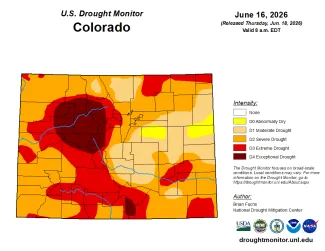
Severe drought tightened its hold on Colorado this week, spreading across more of the state's midsection even as the worst conditions held steady in the high country, according to data released Thursday by the National Drought Mitigation Center. The U.S. Drought Monitor map, which reflects conditions through Tuesday, June 16, shows that every acre of Colorado is now at least abnormally dry, with severe drought or worse covering roughly four-fifths of the state and more than a third mired in extreme or exceptional drought — the two most severe categories on the scale.
Colorado drought conditions as of June 16, 2026. Source: National Drought Mitigation Center.
Snowpack
Colorado's mountain snowpack has effectively melted out for the season, leaving the high country to lean on dwindling reservoir storage and early, depleted runoff. The collapse arrived weeks ahead of normal across the state's SNOTEL network, the culmination of a record-warm winter and a meager spring that the U.S. Drought Monitor's authors cited as the driver behind the poorest pasture and dryland conditions seen in decades across the broader High Plains region.
The consequences are now playing out in streamflow rather than snow. With the snow gone early, high-country streams peaked well ahead of schedule and reservoirs missed much of their usual spring boost, leaving little margin heading into the hottest months. Continued above-normal temperatures across western Colorado have done nothing to ease the strain on soils and vegetation already stripped of moisture.
A year ago the picture was far healthier. In mid-June 2025, the U.S. Drought Monitor recorded no exceptional drought anywhere in Colorado and just 5 percent of the state in extreme drought, compared with roughly 35 percent in those two categories today — a stark measure of how much ground has been lost in a single year.
Drought Conditions
The most severe conditions remain concentrated in the western and central mountains, where exceptional drought (D4) now blankets entire counties. According to the U.S. Drought Monitor, Eagle County, Lake County and Pitkin County counties are entirely in exceptional drought, while Summit County County stands at 88 percent exceptional and 12 percent extreme. Grand County County is 54 percent exceptional and 41 percent extreme, and Garfield County County splits 48 percent exceptional and 41 percent extreme drought.
Exceptional drought also reaches Routt County County (33 percent), Rio Blanco County County (23 percent), Chaffee County County (23 percent) and Gunnison County County (15 percent), according to the U.S. Drought Monitor. Extreme drought (D3) is even more pervasive: San Juan County and Gilpin County counties are entirely in extreme drought, Saguache County County is 99 percent and Huerfano County County 72 percent extreme, while Mesa County County, though only 3 percent exceptional, sits at 57 percent extreme drought.
Conditions also worsened on the eastern plains, where severe and extreme drought continued to expand. Sedgwick County County in the northeast corner is now 92 percent in extreme drought and Baca County County in the southeast 71 percent, according to the U.S. Drought Monitor. Weld County County reached 39 percent extreme drought, with Kiowa County (37 percent), Logan County (30 percent) and Costilla County (40 percent) counties also carrying broad extreme-drought coverage as the last drought-free ground in the state disappeared.
Statistics
Compared with the previous week, Colorado lost the small sliver of land that had been free of drought, with the drought-free share slipping from about 1 percent to zero. The shift was toward the worse: abnormally dry coverage (D0) eased from 4 to 2 percent and moderate drought (D1) edged down from 19 to 18 percent as that ground was pulled into severe drought (D2), which expanded from 40 to 45 percent. Extreme drought (D3) eased slightly from 27 to 26 percent, while exceptional drought (D4) held at 9 percent.
The year-over-year comparison underscores how sharply conditions have deteriorated. One year ago, on June 17, 2025, about 40 percent of Colorado was free of drought, just 5 percent was in extreme drought, and no part of the state had reached exceptional drought. Today no part of Colorado is drought-free, 26 percent is in extreme drought and 9 percent has fallen into exceptional drought — among the worst June readings the state has seen in years.
| Week | Date | None | D0 | D1 | D2 | D3 | D4 |
|---|---|---|---|---|---|---|---|
| Current | 6/16/26 | 0 | 2 | 18 | 45 | 26 | 9 |
| Last Week to Current | 6/9/26 | 1 | 4 | 19 | 40 | 27 | 9 |
| 3 Months Ago to Current | 3/17/26 | 14 | 16 | 29 | 27 | 12 | 1 |
| Start of Calendar Year to Current | 12/30/25 | 29 | 33 | 22 | 13 | 2 | 1 |
| Start of Water Year to Current | 9/30/25 | 46 | 9 | 9 | 22 | 14 | 0 |
| One Year Ago to Current | 6/17/25 | 40 | 15 | 24 | 15 | 5 | 0 |
Just over 4,964,000 Colorado residents live in a drought-impacted area. Colorado's 2023 population was estimated at 5,877,610.
Drought categories include (ranked from least to most severe) abnormally dry (D0), moderate (D1), severe (D2), extreme (D3), and exceptional (D4) drought.
©