Severe drought spreads rapidly across southeast Colorado

Chris Sorensen / (Kiowa County Press)
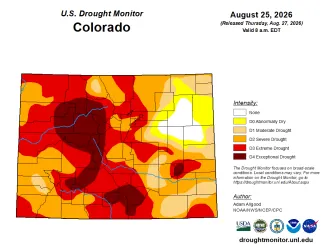
Severe drought pushed across the Arkansas Valley and much of southeast Colorado over the past week as heat and dry weather aggravated agricultural conditions, according to the U.S. Drought Monitor released Thursday by the National Drought Mitigation Center. The map reflects conditions as of 8 a.m. Tuesday, August 25.
Statewide, severe drought or worse now covers 79 percent of Colorado, up from 77 percent a week earlier. Extreme drought pulled back slightly, and exceptional drought — the most severe category on the scale — held steady at 14 percent for a second week, concentrated in the northern and central mountains.
©
Colorado drought conditions as of August 25, 2026. Map courtesy National Drought Mitigation Center.
Snowpack
Colorado’s SNOTEL sites are effectively snow-free at this point in the water year, with automated stations across the high country reporting little or no snow water equivalent. The Natural Resources Conservation Service does not publish a meaningful statewide percent-of-median figure in late August, when accumulation for the coming season has not yet begun.
The more telling measure this time of year is what last winter left behind. The U.S. Drought Monitor noted deterioration in the Rockies of Colorado and Wyoming this week, where water storage impacts from last spring’s limited snow cover are beginning to mount. Reservoir and streamflow deficits built through a poor runoff season are now surfacing in the drought depiction rather than being masked by summer precipitation.
The contrast with the start of the water year is stark. On September 30, 2025, 46 percent of Colorado was free of drought and abnormally dry conditions, and no part of the state was in exceptional drought. Eleven months later, 4 percent of the state is drought-free and 14 percent sits in exceptional drought. A year ago this week, 35 percent of Colorado was drought-free.
Drought Conditions
Exceptional drought remains anchored in the northern and central mountains. Eagle, Pitkin and Lake counties are entirely in exceptional drought, according to the U.S. Drought Monitor. Summit County is 88 percent exceptional drought with the remaining 12 percent in extreme drought, while Grand County stands at 54 percent exceptional, 41 percent extreme and 6 percent severe drought. Routt County is 33 percent exceptional and 67 percent extreme drought after extreme conditions expanded from 93 percent to essentially the entire county this week.
Extreme drought also expanded in Jackson County, climbing from 11 percent of the county a week ago to 21 percent, with 57 percent in severe drought and 23 percent in moderate drought.
The sharpest changes this week came on the eastern plains, where the Drought Monitor described rapid deterioration across southeastern Colorado. In Prowers County, severe drought jumped from 3 percent of the county to 45 percent in a single week, with the remaining 55 percent in moderate drought. Bent County saw severe drought or worse expand from 25 percent to 80 percent, and now stands at 70 percent severe, 7 percent extreme and 3 percent exceptional drought. Otero County followed a nearly identical path, moving from 23 percent to 80 percent in severe drought or worse, with 72 percent of the county now in severe drought.
Farther south and east, Baca County is 44 percent extreme drought and 38 percent severe drought, up from 70 percent to 83 percent in severe drought or worse. Kiowa County remains among the hardest hit on the plains at 17 percent exceptional, 37 percent extreme and 46 percent severe drought, with the entire county in severe drought or worse. Las Animas County is 7 percent exceptional, 27 percent extreme and 27 percent severe drought, while Crowley County stands at 1 percent exceptional, 23 percent extreme and 67 percent severe drought.
There were pockets of relief. Convection east of the Front Range brought improvement across parts of eastern Colorado, and Cheyenne County saw severe drought retreat from 52 percent of the county to 34 percent, leaving 55 percent in moderate drought, 32 percent severe, 11 percent abnormally dry and 2 percent extreme drought.
Statistics
Compared to the prior week, areas with no drought or abnormal dryness expanded from 3 percent to 4 percent of Colorado. Abnormally dry conditions held at 6 percent. Moderate drought contracted from 14 percent to 11 percent, while severe drought expanded from 28 percent to 31 percent. Extreme drought eased from 36 percent to 34 percent, and exceptional drought was unchanged at 14 percent.
One year ago, conditions across the state were considerably better. On August 26, 2025, 35 percent of Colorado was free of drought and abnormal dryness, with 13 percent abnormally dry, 11 percent in moderate drought, 13 percent in severe drought, 21 percent in extreme drought and 7 percent in exceptional drought.
| Week | Date | None | D0 | D1 | D2 | D3 | D4 |
|---|---|---|---|---|---|---|---|
| Current | 8/25/26 | 4 | 6 | 11 | 31 | 34 | 14 |
| Last Week to Current | 8/18/26 | 3 | 6 | 14 | 28 | 36 | 14 |
| 3 Months Ago to Current | 5/26/26 | 0 | 6 | 16 | 37 | 31 | 10 |
| Start of Calendar Year to Current | 12/30/25 | 29 | 33 | 22 | 13 | 2 | 1 |
| Start of Water Year to Current | 9/30/25 | 46 | 9 | 9 | 22 | 14 | 0 |
| One Year Ago to Current | 8/26/25 | 35 | 13 | 11 | 13 | 21 | 7 |
Just over 4,592,000 Colorado residents live in a drought-impacted area. Colorado’s 2023 population was estimated at 5,877,610.
Drought categories include (ranked from least to most severe) abnormally dry (D0), moderate (D1), severe (D2), extreme (D3), and exceptional (D4) drought.