Extreme drought expands in northern Colorado mountains as snowpack lags

© KiowaCountyPress.net
Extreme drought pushed farther across the northern Colorado mountains during the past week, while the rest of the state held largely steady, according to the U.S. Drought Monitor. The map released Thursday, November 19, by the National Drought Mitigation Center reflects conditions as of 7 a.m. EST (5 a.m. MST) Tuesday, November 17.
The Drought Monitor’s High Plains summary described a small degradation in the northern Colorado Rockies this week. On the map, that change shows up as extreme drought spreading through Larimer County and Grand County, while most other categories statewide moved by less than a percentage point.
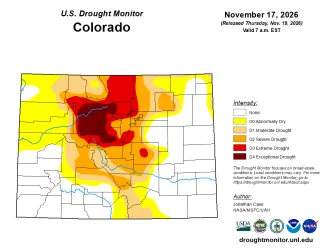
Drought conditions in Colorado as of November 17, 2026.
Snowpack
Early-season snowpack is running well behind normal across the northern and central mountains, according to provisional start-of-day readings from the Natural Resources Conservation Service SNOTEL network on Thursday. Most sites in Grand, Summit, Eagle, Larimer and Boulder counties reported less than an inch of snow water equivalent, with several reporting none. Site readings in Grand and Summit counties ranged from zero to 44 percent of the 1991-2020 median, and Eagle County sites were at 20 percent of median or less.
Water-year precipitation tells a similar story in the north. Since October 1, most sites in Grand and Boulder counties have collected less than half of median precipitation, with most Summit and Larimer county sites below 70 percent. Routt County sites have done somewhat better, at roughly 57 to 102 percent of median precipitation, though snow water equivalent there was under 1.5 inches at every site.
The southern mountains are a different picture. Sites in San Juan, Mineral, La Plata and Hinsdale counties reported from under 1 inch to more than 13 inches of snow water equivalent, mostly well above the median for the date and in many cases one-and-a-half to nearly four times it, with Wolf Creek Summit at 9.7 inches. Water-year precipitation at those sites has run 2.4 to 4.7 times the median. All readings are provisional and have not yet been reviewed by NRCS.
Drought Conditions
Exceptional drought, the most severe category, continues to blanket much of the central mountains, according to the U.S. Drought Monitor. Summit County remains entirely in extreme or exceptional drought, with 88 percent of the county in exceptional drought and the remaining 12 percent in extreme drought. Eagle County has 78 percent in exceptional drought, 12 percent in extreme drought and 11 percent in severe drought. Grand County has 67 percent in exceptional drought and 26 percent in extreme drought, up from 22 percent a week earlier, with the remaining 6 percent in severe drought.
The largest change this week came in Larimer County, where extreme drought grew from 65 percent of the county to 89 percent, with the remaining 11 percent in severe drought. Neighboring Boulder County is 84 percent extreme and 16 percent exceptional drought, and Gilpin County is 92 percent extreme drought with 2 percent exceptional and 6 percent severe. Farther south and west, Lake County is 76 percent extreme and 10 percent exceptional drought, Park County is 22 percent exceptional, 33 percent extreme and 43 percent severe, Routt County is 12 percent exceptional and 26 percent extreme, and Pitkin County is 5 percent exceptional and 22 percent extreme drought. In Jackson County, a trace of extreme drought appeared this week along with 32 percent severe and 57 percent moderate drought.
Southeast Colorado remains clear. Kiowa County, Cheyenne County, Prowers County, Bent County and Baca County are all 100 percent free of any dryness, with neither drought nor abnormally dry conditions on the map.
Statistics
Statewide, the share of Colorado free of any dryness rose slightly to 43 percent from just under that figure a week earlier, while abnormally dry conditions held at about 19 percent. Moderate drought was unchanged at 14 percent. Severe drought slipped from 14 percent to 13 percent as some of that area moved into extreme drought, which edged up to 7 percent. Exceptional drought held at 4 percent. In all, 38 percent of the state is in drought, leaving 62 percent free of drought.
One year ago, 33 percent of Colorado was free of any dryness and 36 percent was abnormally dry. Moderate drought covered 18 percent of the state, severe drought 12 percent and extreme drought 1 percent, with no exceptional drought on the map. About 31 percent of the state was in drought at that time, compared with 38 percent now. Conditions remain far better than three months ago, when 91 percent of Colorado was in drought, including 14 percent in exceptional drought.
| Week | Date | None | D0 | D1 | D2 | D3 | D4 |
|---|---|---|---|---|---|---|---|
| Current | 11/17/26 | 43% | 19% | 14% | 13% | 7% | 4% |
| Last Week to Current | 11/10/26 | 43% | 19% | 14% | 14% | 7% | 4% |
| 3 Months Ago to Current | 8/18/26 | 3% | 6% | 14% | 28% | 36% | 14% |
| Start of Calendar Year to Current | 12/30/25 | 29% | 33% | 22% | 13% | 2% | 1% |
| Start of Water Year to Current | 9/29/26 | 9% | 9% | 24% | 23% | 25% | 10% |
| One Year Ago to Current | 11/18/25 | 33% | 36% | 18% | 12% | 1% | 0% |
About 74 percent of Coloradans live in areas in drought, according to the U.S. Drought Monitor.
The U.S. Drought Monitor ranks conditions from least to most severe: abnormally dry (D0), which is not yet drought, then moderate (D1), severe (D2), extreme (D3), and exceptional (D4) drought.