Weiser beats Bennet in Democratic primary for Colorado governor

U.S. Senator Michael Bennet, once considered the heavy favorite in Colorado’s Democratic primary for governor, was defeated by Attorney General Phil Weiser Tuesday night.
The Associated Press called the race at 7:56 p.m.
Weiser will be heavily favored in November’s general election. Colorado has elected only one Republican governor in the last 50 years, and Democrats are widely expected to gain ground in a favorable midterm election year. The winner will succeed Governor Jared Polis, who is term-limited.
On the Republican side, state Senator Barbara Kirkmeyer, with just under 43% of the vote, led ministry leader Victor Marx and state Representative Scott Bottoms, with 38% and 19%, respectively.
Weiser’s win comes as progressive Democrats in Colorado and across the country look set to celebrate a wave of downballot wins and over-performances, though his own affinities with progressives have had more to do with temperament — and distrust of Bennet — than with policy and ideology. Both he and Bennet are mainstream Democrats who on the campaign trail have been apt to turn a sympathetic ear to establishment business groups while meeting much cooler receptions from insurgent progressive and labor activists.
Bennet once the favorite
Weiser, elected to two terms as attorney general in 2018 and 2022, was the first candidate to enter the governor’s race in January 2025. Bennet, a former Denver Public Schools superintendent who has served in the Senate since his appointment in 2009, followed several months later, in a move that caught much of the state’s political establishment by surprise.
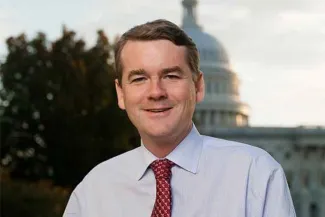
Colorado Senator Michael Bennet
When he launched his campaign in Denver’s City Park in April 2025, he was flanked by much of the state’s up-and-coming Democratic talent, including Representatives Joe Neguse and Jason Crow and Denver Mayor Mike Johnston, and a long list of other establishment figures quickly endorsed his campaign.
Though Bennet began the race as a heavy favorite — one poll conducted in May 2025, and another in February of this year, showed him leading by roughly 30 points — subsequent polling showed Weiser steadily closing the gap as voters tuned in to the primary campaign in May and June. The race grew into a close, expensive and increasingly negative contest — even as the two candidates struggled to identify relatively few specific disagreements when it comes to policies they would pursue as governor.
Both pledged to expand the state’s supply of affordable housing and starter homes, to use their authority where possible to block the Trump administration’s mass deportation agenda, and to meet Colorado’s climate goals while protecting its water rights in an era of worsening drought. Both signaled a willingness to sign some progressive-backed legislation vetoed by Polis in recent years — with the notable exception of the Worker Protection Act, a bill to ease union formation that has been a top priority of Colorado labor groups.
In the absence of major differences in policy and ideology, the two candidates sought to draw contrasts in their leadership styles, with Bennet touting his “vision for the future” and plans to tackle Colorado’s affordability crisis, while Weiser promising to accomplish many of the same goals by being a “fighter” fluent in the inner workings of state government. At times, each candidate accused the other of making unrealistic promises, and they consistently traded accusations of failing to stand up to the Trump administration.
Super PAC spending
Bennet raised more than $5 million from his supporters through June 24, a sum that would have set a new record for primary fundraising by a candidate for Colorado governor — if it weren’t for Weiser’s haul of over $6.7 million.
But Bennet received more than $11.1 million in support from a super PAC, Rocky Mountain Way, whose largest donors were former New York City mayor Michael Bloomberg and Brighter Future for Colorado, a “dark money” nonprofit that does not disclose its donors.
As polls showed the race tightening, the Bennet campaign and Rocky Mountain Way aired ads accusing Weiser of a “pay-to-play” scheme involving donors to the Attorney General Alliance, a group of state attorneys general he chaired in 2022. The ads resurfaced four-year-old accusations that originated with the Public Trust Institute, a “dark money” nonprofit with ties to a conservative advocacy network backing Weiser’s Republican opponent in the 2022 attorney general’s race. Weiser called the accusations “politics at its cynical worst.”
Three-way GOP contest
Kirkmeyer was first elected to the Legislature in 2020 after serving as a Weld County commissioner for nearly two decades. She is a member of the bipartisan Joint Budget Committee, a six-member group that spends months writing a draft of the state budget for the Legislature to approve and leaned on that fiscal experience throughout the primary campaign. Kirkmeyer also led the state’s Department of Local Affairs under former Governor Bill Owens, the last Republican governor.
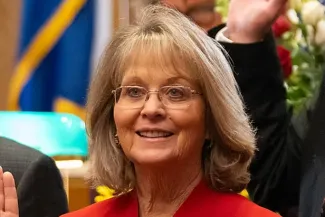
She was widely seen as the less extreme Republican in the primary with the most governance and policy experience. Though part of the establishment Republican Party, she highlighted her bipartisan work throughout the campaign, including on bills to blunt sharp property tax increases in recent years.
Marx is a self-described “high-risk humanitarian” and the founder and CEO of All Things Possible Ministries, a Christian nonprofit based in Colorado Springs that says it has worked overseas in places like Iraq, Syria and southeast Asia. Marx became the center of statewide and national media attention during the primary campaign because of massive fundraising and sensational, yet unsubstantiated, claims about the scope of his work. In one interview with Kyle Clark of 9News, he did not directly answer a question about how many people he has killed.
Kirkmeyer and Bottoms had said they would not support Marx’s candidacy if he won the nomination. In the one debate Marx participated in, his opponents criticized him as a liar and unqualified for the governor’s seat.
Bottoms has been a state representative for Colorado Springs since 2023 and is one of the most conservative members of the House Republican caucus. He is a pastor at the Church at Briargate. Throughout his time in office and on the campaign trail, he focused heavily on culture and social issues such as abortion, transgender athletes and an unfounded claim of pedophilia at the Capitol.