Bureau of Land Management cancels bison grazing leases for American Prairie

The Bureau of Land Management issued a final decision late last week canceling a series of permits that allowed bison grazing on federal land by the nonprofit conservation organization American Prairie.
The move, which came after American Prairie and multiple other organizations formally protested a preliminary decision earlier this year, was condemned by conservation groups but praised by elected officials in Montana, who have sought the cancellation of bison grazing leases for years.
“This final decision is a victory for the rule of law and the generations of Montanans who have stewarded our lands with care,” Governor Greg Gianforte said in a statement. “For far too long, the Biden administration ignored the clear language of the Taylor Grazing Act in favor of an ideological experiment. I’m proud of our administration for leading the fight to reach this decision and I thank Secretary of the Interior Doug Burgum and BLM for putting Montanans first.”
American Prairie has a mission to conserve prairie land in Montana to create one of the largest nature reserves in the country, abutting Charles M. Russell National Wildlife Refuge and Upper Missouri Breaks National Monument. The nonprofit owns and leases more than 500,000 acres in the state.
Across some sections of that leased acreage — specifically six allotments comprising around 63,000 acres of federal land, according to the group — American Prairie grazes around 900 bison under the authorization of the BLM, with some leases stretching back two decades.
“American Prairie has lawfully grazed bison on BLM lands for more than 20 years, complying with every rule, regulation, and permit requirement,” said Alison Fox, CEO of American Prairie. “BLM lawfully issued these permits and recognized that bison are qualified to graze on federal lands under longstanding practice and law. Reversing course now under political pressure undermines trust in the agency’s decision-making and threatens the future of bison restoration across the West.”
The decision by BLM focused on the 1934 Taylor Grazing Act, which is the legal framework that created grazing districts and governs leases on federal lands.
According to the BLM decision, the Act allows permits to be issued “to graze livestock,” and under a new interpretation of federal statutes, bison do not meet the definition of livestock.
Citing a legal dictionary, the decision states that livestock refers to domestic animals “used for production-oriented purposes.”
“The BLM lacks statutory authority to issue grazing permits under the TGA where the animals to be grazed are treated as wildlife and intended for conservation purposes and will not be managed for production,” the decision states.
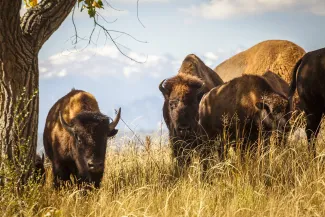
USFWS - public domain
It goes on to state that American Prairie’s bison operations are not domestic nor production oriented.
“This decision affirms what livestock producers have long argued for in the compliance of governing law,” Montana Stockgrowers Association President Lesley Robinson in a statement.
BLM terminated all bison or combined cattle/bison grazing permits for American Prairie and reissued cattle-only grazing permits on six federal allotments. The permit terminations will be effective on September 30, to allow American Prairie to remove its bison herd from the land parcels.
A spokesperson for American Prairie told the Daily Montanan the organization plans to appeal the decision.
“This final decision by the BLM makes it clear that this is an all-out attack on conservation. It is a textbook example of the government moving the goal posts and changing the rules in the middle of the game to reach a predetermined outcome,” said Mary Cochenour, attorney for American Prairie. “There have been no grazing violations, and the administrative record contains objective evidence showing that rangeland conditions have improved over the last two decades with bison on the landscape.”
In addition to the protest lodged by American Prairie, BLM said that the agency received 34 other protest letters that “contained nearly 200 unique protest points,” including many from tribal governments and organizations.
In response to concerns the decision could impact dozens of tribal nations that retaining rights to hunt and manage bison across traditional lands, the BLM notes that its decision is specific to “this particular non-tribal permittee” and the agency is “not adjudicating grazing rights of any tribal governments or representatives.”
According to a 2025 BLM infographic about the agency’s grazing program, there are 41 grazing permits for bison issued by the bureau, alongside 18,000 permits and leases overall (including eight for reindeer.)
The state of Montana originally protested a series of permits issued to American Prairie in 2022, arguing that replacing production livestock with non-production bison damaged the local economy and ignored the statutory requirements for federal grazing permits.
Gianforte and the entire federal delegation, all Republicans, had sent letters to the Trump administration urging the repeal of the bison leases.
Members of the state’s delegation also praised the decision in statements to the press.
“Nobody makes better beef than Montana ranchers. This decision is a return to the original mission the BLM was created for,” said Representative Ryan Zinke in a statement to the media. “The Taylor Grazing Act made clear these lands play a critical role in feeding our nation and sustaining rural communities, they are not meant to be locked up to satisfy the latest Washington political agenda. In Montana, working lands support ranching families who help put food on America’s tables.”
Montana’s senior Senator Steve Daines thanked Interior Secretary Doug Burgum and President Donald Trump for “restoring common sense land management.”
Attorney General Austin Knudsen, who worked on behalf of the state to cancel the bison leases, called the decision a “huge victory” for Montana farmers and ranchers.”
“As someone who grew up farming and ranching in Northeast Montana, I know how important this decision is to protect the hardworking livestock and ranching communities in that region and keep the elitists from destroying their livelihood,” Knudsen said.
Montana is also looking to restrict leases on state land for bison grazing, with a recent proposal by the Department of Natural Resources and Conservation, at the behest of the state Land Board —comprising Gianforte and Montana’s five statewide elected officials including Knudsen — seeking to give preference for bidders involved in “production livestock operations.”
Friday’s decision was signed by Bill Groffy, acting director of the BLM.
A vote to confirm President Donald Trump’s nominee to lead the BLM, Steve Pearce, is also expected soon.