
Colorado evaluates precision-guided aerial water-delivery system for wildfire suppression

Colorado's Center of Excellence for Advanced Technology Aerial Firefighting is testing a GPS-guided aerial water-delivery device designed to suppress new and emerging wildfires earlier and in environments where traditional aircraft cannot safely operate.
The Center of Excellence for Advanced Technology Aerial Firefighting (CoE), part of Colorado's Division of Fire Prevention and Control, is conducting operational testing, evaluation and validation of the Precision Guided Suppression Unit (PGSU), developed by Prime Minute, a public safety and natural disaster response technology company.
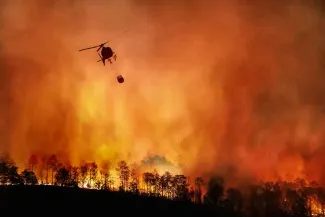
© iStock - Toa55
Unlike traditional aerial water delivery — which requires aircraft to fly low and directly over a fire — the PGSU can be released from 12,000 feet above ground level. After deployment, the unit uses GPS guidance and onboard flight controls to steer toward a predetermined target, with aerodynamic control surfaces that adjust its flight path in response to changing wind and weather conditions.
Each PGSU weighs about 1,000 pounds and carries 110 gallons of water. The operational concept involves an aircraft deploying multiple units over an emerging fire simultaneously, with each unit releasing its water through a dispersal system that spreads the payload across a 35-foot suppression radius.
"This technology offers a unique opportunity to deliver rapid initial attack from new heights. Traditional aerial suppression tools are sometimes limited by the need to fly low and slow over the fire, which restricts when and where they can be used safely. The PGSU allows us to suppress new and emerging wildfires in situations and environments that have previously been out of reach," said Anthony Somogyi, Aviation Projects Manager for the CoE.
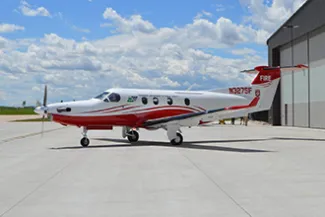
The CoE's testing will assess the PGSU's safety, precision and accuracy, and examine how deploying multiple units could be integrated into existing wildfire operations.
"Public safety has an extraordinary culture of continuous improvement, and those incremental gains make us safer and more effective," said Ben Miller, Director of the Colorado Center of Excellence for Advanced Technology Aerial Firefighting. "But the wildfire environment is changing so rapidly that it demands that we ask whether there is an entirely different way to accomplish the mission."
Miller added: "Incremental improvement will always be essential. But somebody also has to look beyond the next improvement and explore the capabilities we may need tomorrow. At the end of the day, we improve the system after every mission, but to gain ground, we may need to change the system."
Founded in 2014, the CoE is a research and development organization within the Colorado Division of Fire Prevention and Control. Testing of third-party products is strictly for research and does not constitute a commercial endorsement.
More information about the PGSU project is available at cofiretech.gov/pgsu.