Colorado governor candidates pledge to improve state’s business climate

Two Democrats and two Republicans pitched their campaigns for Colorado governor to a roomful of business leaders in Glendale on Wednesday, offering different visions for the state but finding plenty to agree about — with the business community and with each other.
Democratic U.S. Senator Michael Bennet told the forum, organized by groups including Colorado Concern and the Downtown Denver Partnership, that he doesn’t want Colorado “to become Northern California or Southern California.” Bennet faces Attorney General Phil Weiser in a head-to-head Democratic primary, the winner of which will be the heavy favorite to be elected the state’s next governor in November.
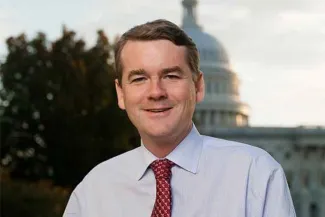
Colorado Senator Michael Bennet
“I want us to be something different, but we can’t do any of it if we don’t have a growing economy,” Bennet told attendees as they ate a catered breakfast at the Infinity Park Event Center. “We can’t do any of it if we’re on the front page of the Wall Street Journal twice in three weeks as being the place that’s repelling business from our state. That won’t work.”
©
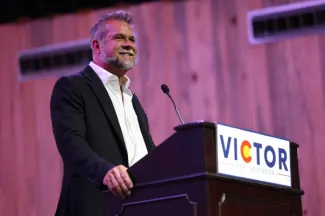
Colorado Springs pastor and first-time candidate Victor Marx, running in a three-way GOP primary, struck a more nostalgic tone, inviting the crowd to recall a “simple” past when kids could ride their bikes at night and “drink from the faucet” when they came inside — but brought things back around to a similar message.
“Remember when, Denver, you could come and not worry about your car being stolen or being mugged?” Marx said. “I believe in that Colorado, and I believe we can get it back. But without the business community to provide jobs, for economical sustainability, with businesses leaving — we’ve got to turn some things around.”
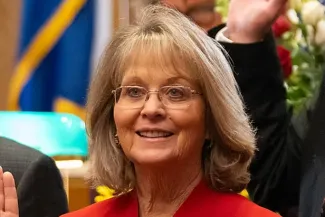
Alongside the Downtown Denver Partnership and Colorado Concern, an advocacy group made up of chief executives from the state’s largest businesses, organizers of Thursday’s forum included the Denver Metro Building Owners and Managers Association, the Denver Metro Commercial Association of Realtors, and the Urban Land Institute Colorado. Bennet, Weiser, Marx and Republican state Senator Barbara Kirkmeyer, also seeking the GOP nomination for governor, made separate 20-minute appearances on stage, where they answered pre-submitted questions from a moderator.
Weiser pointed to Agile Space Industries, a Durango-based rocket manufacturer that recently expanded in Oklahoma, because, he said, “permits that would have taken here months (or) more than a year, in Oklahoma, the same issue got done in days.”

Phil Weiser
“That sets out an agenda for this community,” Weiser said. “An agenda to get the wind at the back of building a growing economic climate, so that Colorado is a place where people want to and can start and build growing businesses.”
Bennet called himself “the only candidate in this race with significant private sector experience,” touting his work acquiring distressed companies for Phil Anschutz, the Colorado billionaire and conservative megadonor, in the 1990s.
“We have amazing assets in this state,” Bennet said. “We have aerospace, we have space, we have national defense, we have energy, we have technology — the depth of these sectors is so much more profound than when I was working for Phil Anschutz all those years ago … So we can turn this state around, but we have to have the right leadership.”
Complaints from the business lobby
Colorado will elect a new governor in 2026 amid a growing chorus of discontent from its conservative business lobby, which has cited recent high-profile corporate relocations and slowing rates of population growth as proof that the state is overburdened by rules and regulations.
The Colorado Chamber of Commerce says it has tracked 98 “relocations or lost opportunities to other states” since 2019, and in an 11-page report released this year it claimed Colorado has enacted an estimated 205,000 “business restrictions,” the sixth-highest total of any state in the country.

iStock - Ratana21
The complaints come despite the fact that Democratic Governor Jared Polis, elected in 2019 and term-limited this year, has consistently angered the progressive wing of his party by blocking legislation he considers anti-business — and despite the rise of the Colorado Opportunity Caucus, a bloc of business-backed Democratic moderates that has come to wield significant power in the Legislature since being formed in 2024.
Earlier this year, when hundreds of business leaders sent an open letter to the state’s top elected Democrats, urging them to “remove barriers and reestablish Colorado as a preferred geography for technology investment,” Polis — an addressee of the letter but a centimillionaire tech investor himself — added his signature.
Business groups also had plenty to celebrate during the 2026 legislative session, which the Chamber itself called “a year in which business concerns were heard.” Colorado lawmakers approved a near-total repeal of a landmark consumer protection law concerning artificial intelligence deployment, killed bills that would have redirected business tax breaks to low-income families, passed a measure to require regular reviews of state regulatory burdens, and more. A bill passed by Democratic lawmakers to ease union formation and another to prohibit surveillance pricing are among the measures expected to be vetoed by Polis soon.
One-party control
Kirkmeyer, a veteran of Colorado Republican politics who has represented Weld County in the state Senate since 2021, blamed the state’s struggles with economic growth and affordability on “one-party control.” Democrats have held all four statewide elected offices and both chambers of the Legislature since first sweeping them in 2019.
“Democrats, for the last eight years now, have made a mess out of our state. We are unaffordable. We are unsafe. We’re unraveling,” Kirkmeyer said. “One-party control has put us in this position.”

© fitimi - iStock-528483210
Even Weiser partially echoed that concern, arguing that state government is in need of “culture changes” when it comes to listening to the business community.
“When you have a state where one party has control, you lose what (former Governor) Roy Romer brought intensely to every conversation, which is, ‘What part of the truth am I missing?'” Weiser said.
“When you have a regulatory policy conversation and the people who would be affected by the regulation are not at the table, you’re not positioned to make good public policy,” he continued. “You’re talking about regulations that went from an anecdote to a proposed bill to enacted and then signed, and the people who the law would have affected felt like they never had a chance to be heard.”
“You talk about an effectively one-party system which we have in the state,” the forum’s moderator, Colorado Politics editor Luige Del Puerto, said to Weiser. “That’s your party, by the way.”