Colorado gray wolf population reaches 32 with strong pup recruitment, CPW reports

Colorado Parks and Wildlife on Thursday released its third annual gray wolf report, identifying a minimum population of 32 wolves statewide and citing strong pup recruitment as an encouraging sign for the state's restoration program.
The report covers biological year 2025-2026, running from April 1, 2025 through March 31, 2026, and was presented to the Parks and Wildlife Commission. It satisfies reporting requirements under state statute (CRS 33-2-105.7(4)), the U.S. Fish and Wildlife Service's nonessential, experimental rule under Section 10(j), and the Colorado Wolf Restoration and Management Plan.
Of the 32 wolves identified, 24 belong to four established packs — 10 adults and 14 pups — while the remaining eight are dispersing adults moving across the landscape. The agency also recorded 10 adult wolf mortalities during the reporting period, three of which remain under investigation by the U.S. Fish and Wildlife Service or CPW.

Colorado Parks and Wildlife
The four established packs build on a wave of expansion last year, when CPW reported three new wolf packs forming in Colorado in 2025.
"This year's annual report highlights CPW's continued efforts to refine and improve our wolf program on all levels, ranging from monitoring to conflict minimization and compensation, and public engagement," said Laura Clellan, director of CPW. "While there is still important work to be done, the report presents a comprehensive picture of the expertise, continued dedication, and expanding capacity of our staff as we work with stakeholders to manage wolf restoration in Colorado."
Wolf Conservation Program Manager Eric Odell said pup recruitment was unusually high, signaling that wolves are pairing, reproducing and surviving in their new range.
"Pup recruitment into the wolf population this year was very high, which is a sign of wolves' ability to find one another, pair, reproduce, and make a go of it in Colorado," Odell said. "While we do not know what the future will hold, this is an encouraging sign of the biological success of our program and displays a positive trend in our wolf population size."
The report includes detailed pack composition for each of the four established packs, including minimum winter adult and pup counts, collared wolf identification numbers and minimum convex polygons of pack territories. CPW plans to maintain at least two GPS collars in each established pack as the population expands.
On the conflict side, CPW's Wildlife Damage Specialists worked with the agency's wolf conflict coordinator, field staff and partners — including the Colorado Department of Agriculture — to deploy nonlethal tools and respond to depredations. During the reporting period the agency conducted 78 additional site assessments, bringing Colorado's total to more than 280, ran 12 night watch events and deployed 61 scare devices and more than 13 miles of fladry across 15 locations.
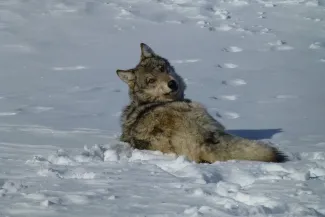
USFWS - public domain
By the close of the biological year, CPW's inventory included roughly 45 miles of fladry and more than 500 scare devices. Contracted range riders worked alongside 34 different producers in northwest Colorado during the 2025 conflict season.
"Our conflict minimization program has grown significantly over the early stages of wolf restoration," said Ray Aberle, deputy assistant director of CPW's Lands Unit. "There is no one-size-fits-all solution to wolf-livestock conflict. Through the expertise of our staff, ongoing training, and expanding hard tool resources, CPW continues to provide timely investigations and strategic response to depredations and wolf localization near working lands."
The agency continues to provide fair market compensation to producers for direct and indirect losses outlined in the management plan, and has signed memorandums of understanding with the Colorado Department of Agriculture and USDA-APHIS covering livestock-predator conflict reduction and depredation investigations.
Ongoing research projects with Colorado State University, CSU Extension, the USGS Colorado Cooperative Fish and Wildlife Research Unit, the USDA-APHIS National Wildlife Research Center and livestock producers are examining ungulate responses to wolf recovery, wolf-livestock interactions and human dimensions of wolf restoration.
Additional information on the report is available on the Colorado Outdoors Blog at coloradooutdoorsmag.com, and the full report can be downloaded through the CPW website at cpw.state.co.us.