EarthTalk - Couldn’t we use bacteria to break down plastic in the environment?

©
Dear EarthTalk:
Couldn’t we use bacteria to break down plastic in the environment so it isn’t such an ecosystem hazard?
Patricia S., via email
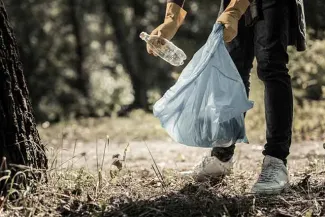
Since 2001, the world has generated over 2.5 billion tons of plastic, an amount expected to triple by 2060. Plastic pollutes beaches and landfills as well as the ocean. In fact, a patch of plastic rubbish as large as Great Britain now exists in the middle of the Pacific Ocean. In addition to traditional bottles or straws causing damage, microplastic particles are also found in fruits, vegetables and water sources such as lakes or rivers. Despite the severity of this issue, only around nine percent of plastic enters a recycling plant and the alternate solution of incinerating plastic releases carbon dioxide that contributes to global warming. The use of bacteria has emerged as an innovative method to mitigate plastic waste. Comamonas bacterium commonly breaks down plastic for food; Ideonella sakaiensis breaks down Polyethylene Terephthalate (PET) plastics. And Japanese scientists have found bacteria consuming plastic in a garbage dump there.
© iStock - yacobchuk
Scientists initially hoped bacteria would simply attack the plastic surfaces, but the bacteria proved capable of doing much more, going so far as to break plastic down fully and process it into basic nutrients. “We have systematically shown, for the first time, that a wastewater bacterium can take a starting plastic material, deteriorate it, fragment it, break it down and use it as a source of carbon,” Ludmilla Aristilde, an environmental chemistry researcher at Northwestern University, told Northwestern Now.
Despite the benefits, the practice of using bacteria for plastic degradation has downsides. Bacteria often degrade plastic into nanoplastics, tiny plastic particles that could potentially cause serious health effects in the human body. Nanoplastics can be found in food, vegetables and water. Thus, if bacteria continue to produce nanoplastics when degrading waste, they may contribute to greater risks to humans, wildlife and ecosystem health. Furthermore, the use of bacteria has significant limitations. Some types of bacteria are much too slow; scientists have also determined that bacteria effectively degrade only softened, pre-treated plastic.
Many scientists are working to improve and develop bacteria for plastic waste mitigation. National Renewable Energy Laboratory researcher Elizabeth Bell enhanced enzymes to degrade plastic much faster with genetic engineering after testing thousands of mutant bacteria. And the French biochem company Carbios processes 250 kilograms of PET plastic daily with bacterial enzymes, creating 51 percent fewer emissions compared to if they were creating new plastic. The European Union is also currently funding research into microbes that can fully biodegrade plastic. Ultimately, while bacteria as a plastic waste mitigative method is still in development, recent progressions have demonstrated its strong potential.
CONTACTS
- We are just getting started’: the plastic-eating bacteria that could change the world, https://www.theguardian.com/environment/2023/sep/28/plastic-eating-bacteria-enzyme-recycling-waste.
EarthTalk® is produced by Roddy Scheer & Doug Moss for the 501(c)3 nonprofit EarthTalk. See more athttps://emagazine.com. To donate, visit https://earthtalk.org. Send questions to: question@earthtalk.org.