Exceptional drought blankets Colorado mountains as heat, failed snowpack drive historic degradation

© KiowaCountyPress.net
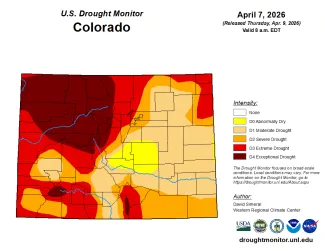
Drought conditions across Colorado worsened again this week, with every corner of the state now classified as abnormally dry or worse and more than two-thirds of the state gripped by severe, extreme, or exceptional drought, according to the National Drought Mitigation Center. The latest U.S. Drought Monitor map, released Thursday and reflecting data through Tuesday, April 7, showed a stretch of northwest Colorado entirely in the worst category the index tracks.
The ongoing drought has prompted federal action, such as the USDA designating 33 Colorado counties disaster areas, as well as prompting Governor Jared Polis to activate the state’s Drought Task Force.
Snowpack
The drought degradation comes as Colorado's mountain snowpack bottomed out far earlier than normal. The Natural Resources Conservation Service is reporting statewide snow water equivalent at the lowest on record, according to the U.S. Drought Monitor's weekly narrative. Historically, peak snow water equivalent in Colorado arrives on April 8. This year, peak occurred a full month earlier, on March 8, leaving the state with a shrinking snow reserve just as irrigation season approaches.
Despite some precipitation falling across western mountain ranges during the past week, any remaining snow is now confined to the highest elevations. In the Colorado River Basin, Lake Powell stands at 24 percent full and Lake Mead at 33 percent full, according to figures cited by the Drought Monitor from the U.S. Bureau of Reclamation.
A year ago, the picture looked very different. On April 8, 2025, nearly half of Colorado — roughly 48 percent — was free of any drought designation, and exceptional drought was absent from the state entirely. Today, not a single acre of Colorado is drought-free, or at least abnormally dry.
Drought Conditions
Exceptional drought — the most severe category on the Drought Monitor scale — now covers about 22 percent of Colorado, concentrated across the northwest mountains and high country. Eagle County, Summit County, Jackson County, Pitkin County, and Routt County are each 100 percent in exceptional drought (D4), according to the U.S. Drought Monitor. Grand County is 98 percent in D4, with the remainder in extreme drought (D3), and Moffat County is 96 percent in D4.
Exceptional drought also extends into Rio Blanco County (86 percent D4), Garfield County (75 percent D4), and the high-elevation basins of Lake County (96 percent D4) and San Juan County (90 percent D4). Farther east along the Front Range, Larimer County and Clear Creek County remain entirely in extreme or exceptional drought, with D4 coverage of roughly 30 percent and 35 percent respectively.
Across the state, the footprint of extreme drought (D2 or worse) expanded only modestly this week, but the coverage of moderate drought (D1 or worse) jumped nearly seven percentage points, from 89 percent a week ago to 95 percent now, as remaining pockets of abnormally dry ground slipped deeper into drought. No part of Colorado is currently drought-free for the first time this water year.
Statistics
Compared with last week's map, abnormally dry (D0) coverage fell from 11 percent to 5 percent as that ground was reclassified into moderate drought (D1), which rose from 24 percent to 29 percent. Severe drought (D2) expanded from 16 percent to 20 percent. Extreme drought (D3) eased slightly from 27 percent to 25 percent, while exceptional drought (D4) held steady at roughly 22 percent. No portion of the state is drought-free.
One year ago, on April 8, 2025, roughly 48 percent of Colorado was not in drought at all, 20 percent was abnormally dry, 20 percent was in moderate drought, 11 percent was in severe drought, and only about 1 percent had reached extreme drought. Exceptional drought was not present anywhere in the state a year ago.
Week | Date | None | D0 | D1 | D2 | D3 | D4 |
|---|---|---|---|---|---|---|---|
Current | 4/7/26 | 0 | 5 | 29 | 20 | 25 | 22 |
Last Week to Current | 3/31/26 | 0 | 11 | 24 | 16 | 27 | 22 |
3 Months Ago to Current | 1/6/26 | 26 | 28 | 30 | 11 | 4 | 1 |
Start of Calendar Year to Current | 12/30/25 | 29 | 33 | 22 | 13 | 2 | 1 |
Start of Water Year to Current | 9/30/25 | 46 | 9 | 9 | 22 | 14 | 0 |
One Year Ago to Current | 4/8/25 | 48 | 20 | 20 | 11 | 1 | 0 |
Just over 4,312,000 Colorado residents live in a drought-impacted area. Colorado's 2023 population was estimated at 5,877,610.
©
Drought categories include (ranked from least to most severe) abnormally dry (D0), moderate (D1), severe (D2), extreme (D3), and exceptional (D4) drought.