Exceptional drought eases in northwest Colorado after mountain precipitation

© KiowaCountyPress.net
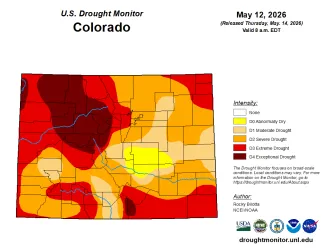
Exceptional drought retreated across portions of northwestern Colorado over the past week as a band of mountain precipitation reached areas that have been entrenched in the most severe drought categories for months, according to the latest map released Thursday by the National Drought Mitigation Center. The map, which reflects conditions through Tuesday, May 12, shows the share of Colorado in extreme (D3) or worse drought falling to about 47 percent, down from 58 percent a week earlier, while exceptional (D4) drought eased to roughly 15 percent of the state.
Even with the improvements, the entire state remains in some level of drought, and the high mountain valleys west of the Continental Divide continue to face the longest-running and most intense conditions, the U.S. Drought Monitor reported.
©
Snowpack
A late-season moisture corridor swept through the western High Plains over the past week, with portions of northern Colorado and adjacent areas of Wyoming and Kansas picking up between 0.7 and 1.6 inches of precipitation, ranging from 0.3 to 0.9 inches above normal, according to the U.S. Drought Monitor narrative. The added precipitation, much of it falling as snow at higher elevations, helped trim the footprint of the most extreme drought categories in the central and northern Colorado mountains.
Conditions remained warmer than usual across most of the state, however, with departures running 2 to 6 degrees Fahrenheit above seasonal norms in western Colorado. That warmth has accelerated runoff and limited the longevity of any new snow at lower elevations, the National Drought Mitigation Center reported.
A year ago, at this point in May 2025, no portion of Colorado was classified in exceptional drought and only about 5 percent of the state sat in extreme drought, underscoring how rapidly conditions deteriorated over the cool season before the late-spring storms began nibbling at the edges of the worst areas.
Drought Conditions
Exceptional (D4) drought, the most severe category, still covers all of Eagle, Summit and Pitkin counties, according to the U.S. Drought Monitor. Routt County remains 94 percent in exceptional drought, with the remaining 6 percent in extreme (D3) conditions, while Grand County saw exceptional drought roll back to 73 percent from 98 percent a week earlier as the eastern portion of the county shifted into extreme drought.
The most dramatic improvement came in Jackson County in north-central Colorado, where exceptional drought fell to less than 2 percent of the county after covering the entire county a week ago. The balance of Jackson County is now in extreme drought. Moffat County in the far northwest corner held at 72 percent exceptional drought, with the remaining 28 percent in extreme drought.
Across the central western slope, Garfield County remains split between exceptional drought at 51 percent and extreme drought at 49 percent, while Rio Blanco County is 38 percent in exceptional drought and 62 percent in extreme drought. Mesa County sits almost entirely in extreme drought at 94 percent, and Gunnison County carries 15 percent exceptional and 56 percent extreme drought coverage, according to the U.S. Drought Monitor.
On the eastern plains, conditions are less severe but still widespread. Kiowa County is entirely in moderate (D1) or severe (D2) drought, with about 72 percent of the county in severe drought, a slight improvement from the prior week.
Statistics
Statewide, moderate or worse drought (D1 through D4) covers 96 percent of Colorado, essentially unchanged from the prior week, while severe or worse drought (D2 through D4) eased to 82 percent from 87 percent. The largest single-week shift came in extreme drought, which declined to 32 percent from 41 percent, with much of that area moving into the severe (D2) category, which expanded from 29 percent to 36 percent. Exceptional drought retreated to 15 percent from 18 percent, while abnormally dry (D0) conditions held steady at 4 percent of the state.
A year ago, no portion of Colorado was in exceptional drought and only 5 percent sat in extreme drought. Severe or worse drought covered just 19 percent of the state in mid-May 2025, compared with 82 percent today, according to the National Drought Mitigation Center.
Week | Date | None | D0 | D1 | D2 | D3 | D4 |
|---|---|---|---|---|---|---|---|
| Current | 5/12/26 | 0 | 4 | 14 | 36 | 32 | 15 |
| Last Week to Current | 5/5/26 | 0 | 4 | 9 | 29 | 41 | 18 |
| 3 Months Ago to Current | 2/10/26 | 27 | 18 | 24 | 22 | 8 | 1 |
| Start of Calendar Year to Current | 12/30/25 | 29 | 33 | 22 | 13 | 2 | 1 |
| Start of Water Year to Current | 9/30/25 | 46 | 9 | 9 | 22 | 14 | 0 |
| One Year Ago to Current | 5/13/25 | 30 | 27 | 25 | 14 | 5 | 0 |
Just over 4,470,000 Colorado residents live in a drought-impacted area. Colorado’s 2023 population was estimated at 5,877,610.
Drought categories include (ranked from least to most severe) abnormally dry (D0), moderate (D1), severe (D2), extreme (D3), and exceptional (D4) drought.