Exceptional drought engulfs mountain counties as Colorado hits 100 percent drought coverage

© KiowaCountyPress.net
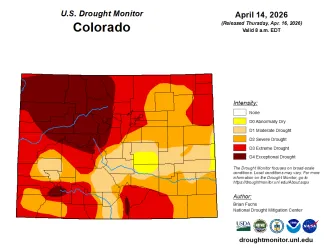
The entire state of Colorado is now classified in some level of drought, with more than one-fifth of the state locked in exceptional drought conditions, according to the U.S. Drought Monitor data released Thursday and valid as of April 14. The National Drought Mitigation Center reported that exceptional drought, the most severe category on the drought scale, expanded significantly across Colorado’s mountain and northwest counties, while the eastern plains experienced nearly a full-category degradation in conditions over the past week.
Snowpack
Mountain snowpack conditions remain a critical concern heading into what should be peak runoff season. Warmer-than-normal temperatures dominated Colorado this past week, with departures running six to eight degrees above normal across much of the state, according to the U.S. Drought Monitor summary. The persistent warmth has accelerated snowmelt timing across the high country, with earlier-than-normal runoff beginning in several basins.
The U.S. Drought Monitor noted that below-normal seasonal snowfall totals and increased liquid precipitation at higher elevations have contributed to mounting hydrological impacts across the West. Colorado’s headwaters counties—including Eagle, Summit, Grand, and Pitkin—are all classified in 100 percent exceptional drought, reflecting the severity of snow deficits in the state’s most important water-producing regions.
One year ago, conditions were markedly different. In mid-April 2025, about 44 percent of Colorado was drought-free, and no portion of the state was classified in extreme or exceptional drought.
Drought Conditions
Exceptional drought now blankets a wide swath of Colorado’s mountain and northwest counties. According to the U.S. Drought Monitor, Eagle County, Summit County, Jackson County, Routt County, and Pitkin County are each classified as 100 percent exceptional drought (D4). Grand County is 98 percent exceptional drought with the remaining 2 percent in extreme drought (D3). Moffat County stands at 96 percent exceptional drought and 4 percent extreme drought, while Rio Blanco County is 86 percent exceptional drought and 14 percent extreme drought.
The eastern plains also saw significant deterioration this week. The High Plains narrative from the Drought Monitor noted that eastern Colorado experienced nearly a full-category degradation, with expansion of moderate, severe, and extreme drought. Kiowa County is now fully in drought, with 87 percent classified as moderate drought (D1), 3 percent in severe drought (D2), and 10 percent in abnormally dry (D0) conditions.
Statewide, the percentage of Colorado in extreme drought (D3) or worse jumped from 47 percent last week to 54 percent this week, while the area in severe drought (D2) or worse climbed from 67 percent to 83 percent. Exceptional drought (D4) held steady at 22 percent of the state.
©
Statistics
This week, none of Colorado is drought-free, unchanged from last week. Abnormally dry conditions (D0) cover 2 percent of the state, down from 5 percent last week. Moderate drought (D1) decreased from 29 percent to 15 percent, while severe drought (D2) rose sharply from 20 percent to 28 percent. Extreme drought (D3) expanded from 25 percent to 33 percent, and exceptional drought (D4) remained at 22 percent.
One year ago, conditions were dramatically less severe. At that time, 44 percent of Colorado was drought-free, 19 percent was abnormally dry, 21 percent was in moderate drought, 15 percent was in severe drought, 1 percent was in extreme drought, and 0 percent was in exceptional drought.
Week | Date | None | D0 | D1 | D2 | D3 | D4 |
| Current | 4/14/26 | 0% | 2% | 15% | 28% | 33% | 22% |
| Last Week to Current | 4/7/26 | 0% | 5% | 29% | 20% | 25% | 22% |
| 3 Months Ago to Current | 1/13/26 | 30% | 23% | 32% | 11% | 4% | 1% |
| Start of Calendar Year to Current | 12/30/25 | 29% | 33% | 22% | 13% | 2% | 1% |
| Start of Water Year to Current | 9/30/25 | 46% | 9% | 9% | 22% | 14% | 0% |
| One Year Ago to Current | 4/15/25 | 44% | 19% | 21% | 15% | 1% | 0% |
Just over 4,665,000 Colorado residents live in a drought-impacted area. Colorado’s 2023 population was estimated at 5,877,610.
Drought categories include (ranked from least to most severe) abnormally dry (D0), moderate (D1), severe (D2), extreme (D3), and exceptional (D4) drought.