
Kansas researchers issue warning about lack of cohesive government response to heat waves

The absence of clear lines of authority among local, state and federal government agencies when responding to deadly heat waves raises questions about the nation’s ability to deal with a warming global climate, University of Kansas researchers say.
The KU researchers concluded the lack of a nationwide framework for heat-related emergencies combined with a shortage of reliable data to map out response strategies complicated work to deal with exceptionally hot conditions potentially more lethal than hurricanes and tornadoes.
“Responsibility varies widely depending on location, with no standard assignment to federal agencies, state governments or local municipalities,” said Nathaniel Brunsell, a KU professor of geography and atmospheric science. “As a result, responses to extreme heat are uneven and often dependent on local capacity rather than a coordinated national strategy.”
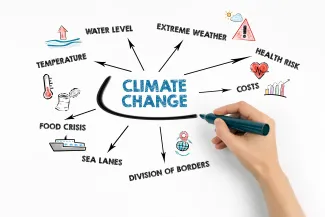
He coauthored research published in the Journal of Climate Change and Health that argued the inconsistencies became more pronounced with shifts in federal policy that diminished availability of emergency services or heightened uncertainty about government authority.
Since 2025, President Donald Trump sought to dismantle federal initiatives intended to address climate change. The Trump administration deleted funding for climate science research, scrubbed websites of environmental data and dismissed government scientists.
Trump’s agenda clashed with evidence of rising global temperatures associated with melting icecaps, rising sea levels and intense droughts, heat waves and storms.
To better understand dimensions of extreme heat, Brunsell worked with KU doctoral student Noah Ring and Dorothy Daly, a KU professor of environmental studies and public administration, to consider how cities responded to heat events.
Brunsell said cities were often responsible for crafting public health plans for responding to heat-related events.
“Unlike other disasters, which often prompt reactive measures such as evacuations or shutdowns, heat requires both proactive and sustained responses,” he said. “These include opening cooling centers, issuing warnings and providing transportation for vulnerable populations. However, many cities rely on existing infrastructure and lack the resources to fully implement comprehensive plans.”
He said assessing the human toll was limited by city-to-city discrepancies in terms of documenting heat-related fatalities.
“This inconsistency makes it difficult to accurately measure the true impact of heat waves or track trends over time, even as meteorological data clearly shows that extreme heat events are becoming more frequent,” Brunsell said. “Translating those climatological findings into human outcomes is far more difficult due to inconsistent data collection.”
The information gap on how extreme heat influenced public health made it more difficult to develop effective interventions, he said.
For example, some low-income communities have less access to air conditioning, which can be significant in terms of coping with heat events. Neighborhoods in the same city might experience different outcomes during the same heat wave.
“Factors such as income, race, occupation and access to education all influence vulnerability,” Brunsell said. “Targeting limited resources effectively requires detailed knowledge of these disparities.”