Oil industry faces uncertainty in what the Bakken’s next era will look like

North Dakota elected officials are pushing to make rapid progress on the next generation of oil production technology before a change in federal administration, but oil and gas executives say there’s no guarantee of a quick breakthrough.
“We have a tremendous opportunity in the next two years, because we have an administration that understands this stuff. We have to get them to mobilize a little faster,” said Governor Kelly Armstrong during a prominent oil conference in May. “Time is the enemy, but they understand this, and so we have gone from headwinds to tailwinds.”
But oil and gas executives say there are a lot of unknowns and success will depend on many factors.
© 4nadia - iStock-1444856274
“Future success is far from a given, it’s going to have to be earned,” said Danny Brown, CEO of Chord Energy. “But the reward is tremendous for this and for future generations.”
The technologies under development by the oil industry, collectively referred to as enhanced oil recovery, are billed as a way to double the amount of oil that can be extracted from the Bakken and expand the life of North Dakota’s oil fields by decades.
The various techniques include injecting chemical surfactants to act like soap to scrape more oil off rock underground, as well as injecting gases, like natural gas, to restore the pressure of an oil reservoir.
The industry has yet to determine what method, or combination thereof, is the most efficient and cost-effective.
“There’s not a silver bullet. We haven’t found one yet,” said Charlie Gorecki, CEO of the Energy and Environmental Research Center at the University of North Dakota, which is working closely with industry on the effort.
There are questions as to whether the methods under development will prove to be profitable.
Whether these enhanced recovery methods will pencil out depends heavily on oil prices, as previous analysis showed even at nearly $100 a barrel, operators remained cautious about ramping up activity.
“Economics are always going to rule the day,” said Pam Heatherington, general manager of ExxonMobil’s Americas division and CEO of Denbury, a subsidiary that focuses on CO2 transport and storage.
Carbon dioxide
Oil companies are working to test some of those methods with large-scale pilot projects in North Dakota, with financial backing from the state and federal governments. But there is still debate and speculation about what works best.
That’s particularly true when it comes to repressurizing a reservoir. Oil and gas reservoirs begin with high pressure and decrease over time as more of the resources are pumped to the surface. Injecting a gas to refill that reservoir’s pressure can lead to improved production.
The industry is searching for a gas that is low-cost, effective and available in large amounts. Companies have tested many possibilities, from propane and natural gas liquids to nitrogen, but carbon dioxide is often considered to be the most feasible option.
“I think CO2 is probably going to be the best long-term option for full scale up across the basin,” said Arvo Buck, director of new ventures at Chord Energy. “It’s going to take a tremendous amount of volume, and I just can’t say that enough.”
Carbon dioxide brings its own challenges. One is finding a supply.
The best supply is from ethanol plants because it has a high purity, said Brad Musgrove, Williston Basin asset manager for Devon Energy.
“But it’s limited supply and not necessarily available in the field,” Musgrove said.
Summit Carbon Solutions’ proposed CO2 pipeline to North Dakota would have collected CO2 from ethanol plants in five states, but that pipeline project has been rerouted to Wyoming.
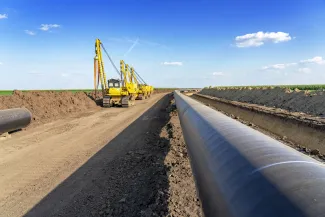
If a supply of carbon dioxide is available, the next challenge would be developing new CO2 pipelines to deliver it to oil wells.
“At scale, the need for CO2 is tremendous,” Brown said, adding that North Dakota doesn’t produce enough and will need to import more.
If that new infrastructure is built, the industry will still have to prepare for the higher percentage of CO2 that will come back to the surface when a repressurized well begins producing oil again, Musgrove said.
Chevron executive Birlie Bourgeois explained that carbon dioxide will mix with water underground and create carbonic acid. Oil wells were not designed to handle that, and virtually every piece of oil infrastructure would have to be retrofitted, he said.
“That’s going to eat through pipe really quickly, so it is a huge capital burden if you’ve got to go retrofit every facility and every well to mitigate against that,” Bourgeois said. “We really need smart minds to help us come up with solutions there because if you could do that and not have to retrofit everything, like that’s a great solution.”
Dimmer switch, not a light switch
Government officials, led by Armstrong and U.S. Senator John Hoeven, R-N.D., are leading the charge to make rapid progress in order to keep the oil, and the tax revenues that come with it, flowing in the state.
“We’ve only tapped 15% of the Bakken and Three Forks. The other 85% is still trapped in the rock. If we can create the policy and the incentives, and you all can unlock even another 15% with EOR, that’s an entirely new boom,” Armstrong said to thousands of oil and gas executives and workers.
Kyle Haustveit, a Tioga native recently confirmed as an undersecretary with the U.S. Department of Energy, said North Dakota is primed to lead the nation in finding a way to make that happen.
Haustveit warned in an interview the deployment of the technology will not be as quick as some are hoping. It will be more of a “dimmer switch” rather than a light switch, and it could be five years before the industry begins to widely deploy enhanced oil recovery in unconventional shale oil fields like the Bakken.
© iStock - lagereek
“The shale revolution was much more of a light switch, because we were energy dependent, importing oil prices skyrocketed, and the industry stepped up. But even that being more of a light switch still took multiple years to reach peak production,” he said. “It’s probably gonna be 10 or 15 years before we see a big incremental increase in U.S. oil production from unconventional EOR.”
The importance of finding a way to extract a greater percentage of the oil in shale formations extends beyond North Dakota. Vishal Gupta, president of EOR Ventures for Occidental Petroleum, said the growth of shale oil production in the United States is slowing down and will likely peak within five to eight years before entering a “fairly steep decline.”
“Whereas the U.S. currently makes up about 15% of the global oil supply, this could be as low as 3% by the year 2040,” Gupta said. “We believe that it’s critically important for us to start investing in EOR now, so that we can offset this decline.”
While the bulk of the burden for avoiding that decline falls on the oil and gas industry, government policy will play a significant role as well. Lynn Helms, former state regulator and project manager for enhanced oil recovery efforts for the North Dakota Petroleum Council, said it’s crucial for North Dakota to ensure companies feel comfortable investing the necessary resources.
“The enemy of capital deployment is uncertainty,” Helms said.