Extreme drought expands in eastern Colorado as exceptional conditions grip the high country

© KiowaCountyPress.net
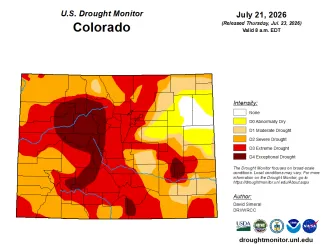
Extreme drought expanded across portions of eastern Colorado over the past week as hot temperatures, dry conditions, and elevated evaporative demand took a further toll on the region, according to data released Thursday by the National Drought Mitigation Center. The latest map, based on conditions as of Tuesday, July 21, shows less than three percent of the state free from drought or abnormally dry conditions, with nearly half of Colorado in extreme or exceptional drought.
Snowpack
Colorado's mountain snowpack has long since melted out for the season, and the legacy of the past winter's meager snow accumulation continues to define conditions across the high country. Streams and reservoirs that depend on melting snow through the summer months entered the runoff season with a substantial deficit, leaving soil moisture depleted and vegetation stressed across the central mountains.
The contrast with last year is stark. One year ago, nearly 43 percent of the state was free of drought or abnormally dry conditions, and no part of Colorado was in extreme or exceptional drought, according to the U.S. Drought Monitor. This week, exceptional drought - the most severe category - covers 12 percent of the state, centered on the mountain counties that form the headwaters of the Colorado, Eagle, Roaring Fork, and Arkansas rivers.
Drought Conditions
Conditions remain most dire in the central mountains, where Eagle County, Pitkin County, and Lake County counties are entirely in exceptional drought, according to the U.S. Drought Monitor. Summit County is close behind, with 88 percent of the county in exceptional drought and the remaining 12 percent in extreme drought. In Grand County, 54 percent of the county is in exceptional drought, with another 41 percent in extreme conditions, while Routt County reports 33 percent exceptional and 13 percent extreme drought.
Closer to home, this week brought degradation across the eastern plains. In Kiowa County, 20 percent of the county is now in exceptional drought and another 32 percent is in extreme drought, with nearly all of the remainder in severe drought. Neighboring Crowley County shows 21 percent exceptional and 30 percent extreme drought, while Lincoln County reports seven percent exceptional and 35 percent extreme conditions. In Bent County, eight percent of the county is in exceptional drought and 16 percent is in extreme drought. Cheyenne County has so far escaped the worst conditions, with 10 percent of the county in extreme drought and just over half in severe drought or worse.
The National Drought Mitigation Center noted that areas of eastern Colorado and southeastern Wyoming saw degradation over the past week in response to dry conditions, excessive heat, and elevated evaporative demand.
Statistics
Compared to the prior week, the area of the state free from drought or abnormally dry conditions was unchanged at three percent, while abnormally dry conditions held steady at seven percent. Moderate drought slipped from 10 to nine percent, and severe drought fell from 34 to 32 percent as conditions deteriorated into higher categories. Extreme drought expanded from 34 to 37 percent of the state, while exceptional drought was unchanged at 12 percent.
One year ago, 43 percent of Colorado was free of drought or abnormally dry conditions. Abnormally dry conditions covered 12 percent of the state, with moderate drought at 14 percent, severe drought at 22 percent, and extreme drought at nine percent. No exceptional drought existed anywhere in the state at that time.
| Week | Date | None | D0 | D1 | D2 | D3 | D4 |
|---|---|---|---|---|---|---|---|
| Current | 7/21/26 | 3 | 7 | 9 | 32 | 37 | 12 |
| Last Week | 7/14/26 | 3 | 7 | 10 | 34 | 34 | 12 |
| 3 Months Ago | 4/21/26 | 0 | 2 | 9 | 32 | 36 | 22 |
| Start of Calendar Year | 12/30/25 | 29 | 33 | 22 | 13 | 2 | 1 |
| Start of Water Year | 9/30/25 | 46 | 9 | 9 | 22 | 14 | 0 |
| One Year Ago | 7/22/25 | 43 | 12 | 14 | 22 | 9 | 0 |
Just over 4,655,000 Colorado residents live in a drought-impacted area. Colorado's 2023 population was estimated at 5,877,610.
Drought categories include (ranked from least to most severe) abnormally dry (D0), moderate (D1), severe (D2), extreme (D3), and exceptional (D4) drought.
©
Colorado drought conditions as of July 21, 2026. Map courtesy National Drought Mitigation Center.