
The flood is still arriving at Lake Powell: the biggest day since October 22 came after the rain stopped

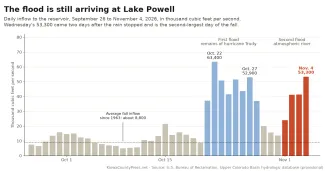
The rain over the San Juan Mountains ended Monday morning. Wednesday, Lake Powell took in 53,300 cubic feet per second, the most water in a single day since October 22 and the second-largest day of the whole fall. The U.S. Bureau of Reclamation's daily record put the lake at 3,535.9 feet Wednesday night, 17.6 feet above where it stood on October 1 and 19.3 feet above the record low it set September 15. The lake is now higher than it has been since January 26. Reclamation had not posted Thursday's figures by Friday morning.

© iStock - djperry
The reason is travel time. The water the second storm put into the San Juan at Pagosa Springs and Farmington on Sunday and Monday took two to three days to come down the river and through the San Juan arm of the lake, and Reclamation measures inflow by the rise of the lake itself. One more big day followed. The San Juan near Bluff fell to 20,800 cubic feet per second Wednesday afternoon, rose again to 31,100 on Thursday, and was down to 17,100 and falling fast early Friday, with the gauges above it at Shiprock and the Four Corners back under 8,000. Thursday's inflow to the lake should be the last large one. After that the river is draining.
What five weeks of water did
Since October 1, the first day of the water year, Lake Powell has gained 1.02 million acre-feet, from 5.17 million to 6.19 million, a little more than a quarter of capacity. The 1.6 million acre-feet that flowed in between October 1 and November 4 is the most for that stretch of the calendar in Reclamation's record, which begins in 1963. The old mark was 1.38 million in 2006. October alone ranked second behind 2006, as the Press reported Wednesday. November has started faster still. The first four days brought 316,000 acre-feet, more than twice the 155,000 that opened November 1986, the previous record, and already 62 percent of what an average full November delivers.
©
Wednesday's inflow of 53,300 cubic feet per second has been matched or beaten on only four other October or November days in 63 years: October 6 and 7 of 2006, October 22 of this year, and a day in October 1972 that was essentially the same. For comparison, the average fall day since 1963 brings the lake about 8,800.
The water came mostly down the San Juan. The Bluff gauge averaged about 29,800 cubic feet per second on Tuesday. The Colorado River near Cisco, which carries the main stem out of Colorado, crested at 17,700 late Monday night and averaged 15,600 Tuesday, and the Dolores added about 6,000. The Green River, which drains Wyoming and the Uinta Mountains and missed both storms, ran 4,700 to 7,600. Add them up and about 56,000 cubic feet per second was headed for the lake on Tuesday. It arrived Wednesday.
The water Navajo kept
The second flood would have been larger at the lake if Navajo Reservoir had not caught it. Navajo took in 195,000 acre-feet between Sunday and Tuesday, more than 100,000 of it on Monday alone, while the dam released about 260 cubic feet per second. The reservoir rose 17 feet in four days and is now about 81 percent full, with 1.37 million acre-feet, against 67 percent at the end of October. That water is not lost to Lake Powell. It will come down the San Juan next year on Reclamation's schedule instead of in a wall of water this week, which is what the dam was built for.
McPhee Reservoir on the Dolores gained 38,000 acre-feet in four days and Vallecito 16,000. Both are also holding water that would otherwise be at Lake Powell now.
Lake Mead
Lake Mead stood at 1,039.3 feet Wednesday, 2.1 feet above the record low of 1,037.16 it set October 22. Glen Canyon Dam has released a steady 6,500 to 6,700 cubic feet per second all fall, and Hoover Dam released 7,700 Wednesday, so Mead is gaining slowly on the small difference. None of the flood water reaches Mead. It stays behind Glen Canyon Dam unless Reclamation changes the release, which it has not.
What this does and does not change
Reclamation's October 24-Month Study, written before either flood, projected Lake Powell at 3,518.3 feet at the end of December. The lake passed that mark on October 2 and is 17.6 feet above it with eight weeks of the year left. The November study, due about November 13, will be the first to count both floods, and the first that could revise the release range for the water year, which the October study set at 6.0 to 7.0 million acre-feet. Those are the numbers that decide how much water reaches Lake Mead, Arizona, Nevada and California in 2027.
What the floods did not change is the size of the hole. At 3,535.9 feet the lake is 164 feet below full and 46 feet above the elevation at which Glen Canyon Dam can no longer generate power. The 1.6 million acre-feet of the past five weeks is 17 percent of what an average water year brought the lake from 1991 to 2020, 9.5 million acre-feet by Reclamation's own daily record. It is also more than a third of everything the lake received in the water year that ended September 30, which was 4.46 million, less than half of average. The spring runoff that supplies most of a normal year depends on snow that has not fallen yet. The storm that crossed Colorado Wednesday night was forecast by the National Weather Service to put 4 to 8 inches on the central mountains above 10,000 feet, and the week ahead is dry and warm. Whatever snow fell drains to Lake Powell too, in April and May.
Reclamation's daily figures for Lake Powell are at usbr.gov. All of them are provisional. The Press's earlier reports on the lake are here and here.