Las Vegas serves as case study for groundwater recovery, study says

© artzenter - iStock-509493427
Groundwater depletion is a growing concern for regions that need to provide water for growing cities and thirsty agriculture in a drying climate, but Las Vegas offers a case study for how intervention can help stabilize a major source of portable water.
New research published in Science Magazine Thursday documents dozens of cases of “groundwater recovery” across the globe — where groundwater levels rose after a prolonged period of depletion.

Las Vegas stood out as a rare case of groundwater levels recovering significantly after intervention through artificial recharge, which involves direct injection of treated unused Colorado River water into the local groundwater aquifer.
Since 1987, the Las Vegas Valley Water District (LVVWD) and its partners have stored more than 360,000 acre-feet of treated water, or roughly 117 billion gallons, in the local underground aquifer — a major shift after decades of intensive groundwater use that caused once free-flowing artesian wells in the valley to run dry.
“At a global scale, there are a lot more places where groundwater levels are declining than there are places where groundwater levels are recovering,” said Scott Jasechko, a professor at UC Santa Barbara and the author of the study.
“Yet these relatively rare cases of groundwater recovery, in my view, are important to study because they provide examples as to the kinds of things that we might do to try to address the problem of groundwater depletion,” he continued.
Those interventions have allowed groundwater levels in Las Vegas to remain relatively stable despite total annual water use increasing since the 1980s. However, groundwater recovery in Las Vegas was only made possible due to more reliance on surface water.
More than 80 percent of the 67 groundwater recovery cases reviewed in the study involve municipalities securing alternative water sources to offset groundwater demands, including Las Vegas.
© mheim3011 - iStock-544332118
Until 1971, groundwater was the only source of water in the Las Vegas Valley. Now only 10 percent of the water used in the Las Vegas valley comes from groundwater, while the rest comes from Lake Mead.
Still, nearly 40 years of artificial recharge has set the valley apart when it comes to groundwater management, according to the analysis. Las Vegas was one of the first cities to run a managed aquifer recharge program.
“In some areas, particularly close to those injection sites, groundwater levels have recovered at a relatively rapid rate,” Jasechko said of Las Vegas. “The recovery is most dramatic close to the injection sites, but even a little bit further away, there has been recovery throughout the valley.”
By 1990 areas of the Las Vegas valley that had once supported flowing artesian wells experienced water level declines of more than 300 feet, according to the U.S. Geological Survey. Before those declines, the Las Vegas Wash supported more than 2,000 acres of wetlands. By the 1990s, only about 200 acres of wetlands remained.
While successful at reversing some groundwater depletion, artificial recharge has not managed to restore groundwater in Las Vegas to its original levels. Data from well sites show that some parts of the valley are still experiencing declines.
“There are still places in the Las Vegas Valley, particularly in the northwest and also southeast, where groundwater level declines continued even after the 1980s injections began,” Jasechko said.
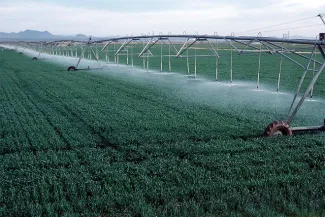
Center pivot irrigation of crops in Yuma County, Colorado. Courtesy USDA
Las Vegas continues to extract upward of 71,000 acre-feet of groundwater per year, nearly three times the natural recharge rate, according to the Nevada Division of Water Resources.
Groundwater decline has also created environmental issues that persist despite efforts to recover groundwater, including subsidence.
The City of North Las Vegas was the first area to experience large water-level declines and resulting subsidence, most notably in the Windsor Park area of North Las Vegas, which forced most residents to relocate and continues to impact remaining residents to this day.
In Las Vegas, groundwater recovery has had the added benefit of improving groundwater accessibility by reducing the energy required for pumping, according to the study.
Jasechki emphasized that the cases analyzed in the study were only a fraction of the entire groundwater story in the Southwest.
For example, about 20 percent of Nevada’s groundwater basins are currently over-pumped, according to the Nevada Division of Water Resources. A recent study also found that almost 40 percent of groundwater wells in the state are in decline.
“Some of the most rapid rates of groundwater decline globally are indeed occurring in aquifer systems in the southwestern United States,” Jasechki said. “This research highlights some good news cases, but there are a lot more places where things are bad than places where things are good.”
Without careful groundwater monitoring the improvements could reverse, said Jasechki. The analysis found that in some cases groundwater depletion continued even after new water policies were introduced, as seen in northern Jordan and northern Tunisia.
The study highlights policies and actions that could help reverse groundwater depletion and the benefits of groundwater recovery. In two-thirds of groundwater recovery cases, municipalities implemented two or more types of interventions.
In Las Vegas, those interventions included finding alternative water sources, reductions in pumping, and artificial recharge via injection wells.
“Las Vegas is one of the more interesting cases to me, because it highlights what can be achieved when there is a surface water body nearby,” Jasechki said.
“Groundwater depletion is not some foregone conclusion, and there are things we can do to turn this problem around. For stakeholders that are interested in trying to solve the problem of groundwater depletion in the location where they are, there are cases around the globe where they might look to and borrow some of the strategies,” he continued.